

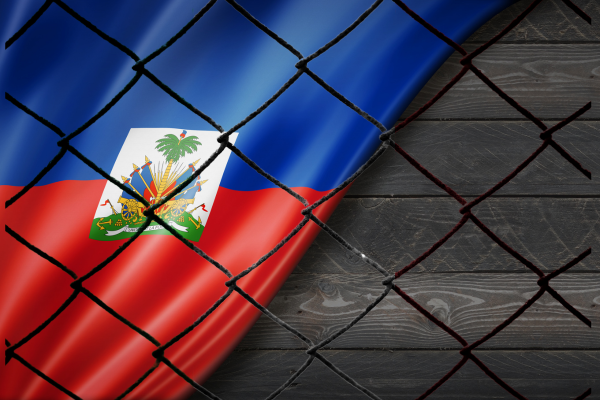
Image created by Shana Black
This story originally appeared in The Emancipator. Republished with permission
Hyperbole and xenophobia obscure the untenable reality for Haitians in the U.S. — a country of origin too dangerous to return to, and a host nation increasingly hostile to their presence.
A few days after Donald Trump’s reelection, a chilling ripple coursed through the Haitian community of Springfield, Ohio. Families packed hastily and fled the city in fear of imminent deportation.
Their leaders, with a mix of pragmatism and despair, urged them to stay. “Leaving in droves,” they warned, “would be futile. There are no good options.”
This grim calculus encapsulates the uncertainty gripping Haitian immigrants — legal or undocumented — as they brace for the wave of punitive policies from the incoming Trump administration. While specific actions have yet to come into focus, the ominous contours of his rhetoric signal a dismal future. Trump has promised mass deportations “the likes of which we’ve never seen before,” a threat as chilling as it is amorphous.
If past is prologue, however, the bluster of such pronouncements may overshadow their implementation. Trump’s infamous border wall — which he claimed Mexico would fund — was more a symbol of division than an engineering feat, a partial fence erected at taxpayers’ expense. But any comfort gleaned from his pattern of overpromising and underdelivering would be naive. The chaos of Trump’s first term taught us that even failed policies can create widespread harm, stoke fear, divide communities, and empower fringe elements.
For Haitian immigrants, the stakes are existential. Many have no viable path back to Haiti, a nation teetering on the brink of collapse. Its current crises — gang violence, political instability, and economic despair — are among the worst in its troubled history. Returning there is not an option; staying put is fraught with peril. They are, as the French poet Charles Baudelaire wrote, “like shipwrecked men clinging to debris.”
The presence of Haitians in Springfield and other parts of the Midwest is itself a recent paradox. Historically, Haitian immigrants have clustered in metropolitan areas like Miami, New York, and Boston, drawn by established communities and a shared cultural infrastructure. But during Trump’s first term, his administration — in a twist of irony — facilitated the dispersal of Haitian workers to the Midwest. States like Ohio, Indiana, and Kentucky, desperate to revive their faltering economies, lobbied Washington for labor. Temporary protected status brought Haitian immigrants to towns hollowed out by industrial decline. Their arrival helped resuscitate local economies, filling jobs that locals often shunned.
Trump’s infamous border wall — which he claimed Mexico would fund — was more a symbol of division than an engineering feat, a partial fence erected at taxpayers’ expense.
Now, those same communities face an ugly inversion. Immigrants once welcomed as economic saviors are recast as scapegoats for societal woes. Vice President-elect JD Vance, Ohio’s MAGA-aligned senator, typified this rhetoric, falsely claiming that Haitians were “eating people’s pets” in Springfield. Local officials swiftly debunked these inflammatory remarks, but the damage was done. In the Trumpian playbook, truth is sacrificed in service of spectacle, and marginalized groups — like Haitian immigrants — are easy targets.
This toxic environment is compounded by Haiti’s portrayal as a “failed state,” an epithet Trump himself put in even cruder terms. The political discourse around immigration is often bereft of nuance, awash instead with hyperbole and xenophobia. Few acknowledge that most Haitians came here legally, working in programs designed to bolster the very communities that now turn against them. Fewer still grasp the untenable reality they face: a country of origin too dangerous to return to, and a host nation increasingly hostile to their presence.
The strategy to counteract this impending storm hinges on the courts. Organizations like the American Civil Liberties Union (ACLU) are poised to challenge any unconstitutional overreach. Already, a phalanx of lawyers is mobilizing, prepared to file case after case to halt policies that would devastate immigrant communities. Yet, legal remedies are not panaceas. Court battles take time, resources, and public will — all of which can wane in the face of relentless, protracted political and cultural assaults.
At the grassroots level, coalitions are forming to shield immigrant communities from the worst effects of Trump’s renewed presidency. Groups working at the intersection of refugee aid and community support are doubling down on efforts to counteract misinformation, provide legal aid, and foster solidarity. These coalitions span the country, from the progressive enclaves of California to the immigrant hubs of New York, aiming to blunt the edges of an administration bent on stoking division.
What might the next four years hold for Haitian immigrants? The possibilities range from grim to grimmer. In the most draconian scenario, mass deportations could commence, tearing families apart and devastating communities. Even without mass action, stepped-up Immigration and Customs Enforcement raids could create a climate of pervasive fear, discouraging immigrants from accessing essential services or reporting crimes. Legal immigrants might also find themselves ensnared in an administration eager to reinterpret the rules of engagement.