

By Conor Morris
East Side Cleveland resident Dennis Eads ran into some trouble paying rent last year. Eads, a father of five, said he was thankful to have kept his job at a warehouse in the Cleveland area despite the pandemic. But, some of his children got sick, which meant he couldn’t go to work.
“I had to quarantine at the house; I couldn’t go outside, couldn’t go to work, couldn’t get paid,” he said.
That on top of his own medical issues meant Eads fell behind on his rent. He was recovering financially and physically from being shot in the head when he lived in Columbus in 2018. He was homeless for a brief stretch after that happened.
When Eads didn’t pay his rent, it put his landlord, Karen Polk, in an awkward position, she said in a separate interview. Polk, an Oakwood Village resident who owns about a dozen rental properties, said she had not received rent from Eads for several months late last year.
So, she filed an eviction claim against him.
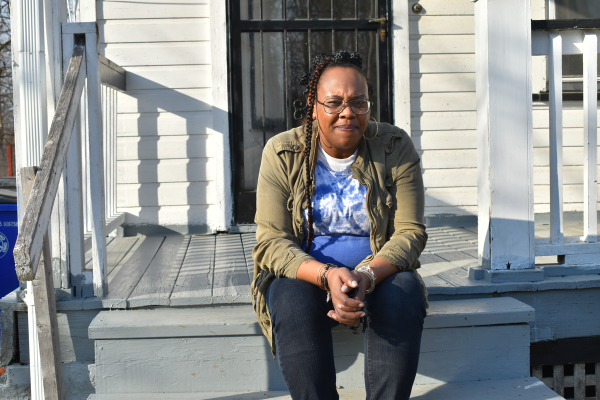
Denesha Moses sits on her porch in the Buckeye-Woodhill neighborhood. Moses received help from the Cleveland right to counsel program last year after her former landlord filed an eviction against her. Photos by Conor Morris.
When Eads showed up to Cleveland Housing Court, he met Lauren Hamilton, an attorney with the Legal Aid Society of Cleveland. After being screened (there are two legal aid attorneys present during most hearings), Hamilton told Eads he qualified for free legal representation under Cleveland’s Right to Counsel program, operated by Legal Aid and the United Way of Greater Cleveland.
Right to counsel (RTC) programs like the one in Cleveland are trying to solve a significant issue in the US: tenants often do not have legal representation in eviction cases, typically because they cannot afford it. Without a decent legal defense, judges are more likely to grant the eviction against the tenant. And when a person is evicted, there are cascading negative effects on their health, economic wellbeing and for society at large.

This charts show the disproportionate number of evictions that are filed against Black Clevelanders, and how they’re getting help from the right to counsel program. Graphics provided by United Way of Greater Cleveland
Only 2% of tenants had legal representation on average in Cleveland Housing Court before the RTC program, Legal Aid Executive Director Colleen Cotter said during a recent Cleveland City Council finance committee meeting. Now about 20 percent of these tenants have had access to a lawyer since RTC started in July 2020. Polk, Eads’ landlord, said she didn’t want to file the eviction; she grew up in inner-city Cleveland seeing her neighbors struggle, so she understood Eads’ plight. But she said she had her own financial struggles during the pandemic.
When she called Hamilton to vent her frustration, the two discovered paperwork for Eads’ rental aid application was incomplete. Hamilton called the Cleveland Housing Network, with whom Legal Aid works closely, and within a few hours, Polk received an email confirming the rental aid money was coming.
“I was surprised,” she said. “I thanked her for doing what she was doing. She went over and beyond most attorneys in my mind.”
She said she thought it was a “win-win” for both her and Eads. She and Eads also both said they’re now communicating better with each other thanks to mediation from Hamilton.
Melanie Shakarian, a Legal Aid spokesperson, said the RTC program has been especially effective because it’s paired with rental assistance, providing a good avenue to encourage landlords to drop their eviction cases even if the tenant missed months of rent payments.
However, Hamilton cautioned that the rental assistance is mostly a “Band-Aid” for people who are struggling.

These charts show the disproportionate number of evictions that are filed against Black Clevelanders, and how they’re getting help from the right to counsel program. Graphics provided by United Way of Greater Cleveland
The RTC program has seen a lot of use since its inception last July. Statistics provided by the Legal Aid Society show that Legal Aid’s 10 RTC attorneys had taken on about 380 cases in Cleveland Housing Court between July and Dec. 31, 2020. That number likely would be higher had the federal government not enacted a moratorium on evictions because of COVID-19, a temporary halt set to expire on July 31.
Still, the RTC program is showing early signs of success, according to an interim report on the program’s success released in February. About 93% of the RTC clients who faced an eviction or involuntary move were able to avoid being displaced because of the legal representation they received.
But there are limits to its efficacy: the program is only available to people living in Cleveland who have children in the household and earn at or below the federal poverty line, or $21,720 per year for a family of three. This means there are significant groups of the population who aren’t eligible, excluding about 62% of tenants who typically show up to Cleveland’s Housing Court, according to the interim report.
While it’s not a true RTC program, Cuyahoga County did provide $1 million to Legal Aid earlier this year from federal COVID relief funds to pay for free legal representation for people living in the county who face eviction and are below 200% of the poverty line. Shakarian said this new funding came after county officials saw the early success of RTC.
Anyone interested in learning more about these programs can go to https://freeevictionhelp.org/, or see if they are eligible by calling (216) 861 5835.
This story is sponsored by the Northeast Ohio Solutions Journalism Collaborative, which is composed of 20-plus Northeast Ohio news outlets including Black Girl in the CLE. Conor Morris is a corps member with Report for America. You can email him at conor@thedevilstrip.com.