

Texture, as defined by Oxford English Dictionary, is the feel, appearance, or consistency of a surface or substance. It is both a noun and a verb. It is alive.
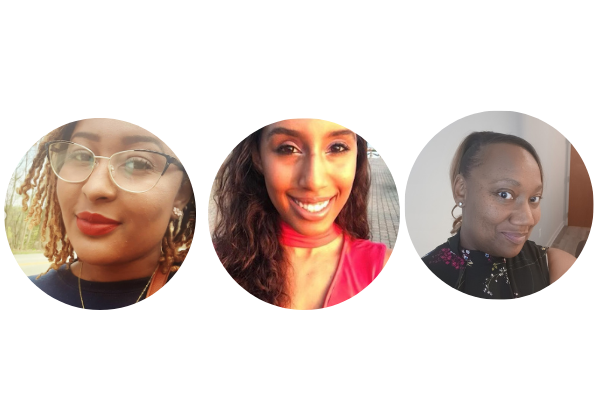
By Laylah Allen, Kelcy Eady and Ashley Sowers
The Exhibit
Textures: The History and Art of Black Hair is a landmark exploration of black hair. It compiles historical research, culture, fashion, and artistry into a visual showcase that pushes viewers to pursue further independent research and spark conversations surrounding personal experiences. It is available for view from now until August 2022. Get your life for less than 10 bucks or go for free on Sunday’s.

Laylah: The exhibit has textural paintings capturing moments of the everyday lives of black people. I was immediately captivated by the use of bright, bold colors. I also found myself gravitating towards historical documents including black hairstyle ads from the 1970’s, the State Board of Cosmetology application from 1955, and the book cover for 400 years Without A Comb. Reviewing such raw materials of black history tells the story of the obstacles my ancestors endured in pursuit of what I’m molding my child to be–free to love and display her hair unapologetically.
Kelcy: Seeing our history laid out before us ignited within me feelings of sadness as I thought about all of the heartache and physical pain that many endured by both colorism and hairstyling; The kind of pain that some went through for decades and that some still experience today. Then I felt so much love as I think about the bonding our people share in barber shops, kitchens and front stoops across the world; and feelings of pride as I watched my own daughter grin as she walked through the exhibit, seeing women with hair as she put it “just like mine.”
Ashley: The TEXTURES exhibit at Kent State is much needed, but also just a start. Outside of the brilliant artwork showcased, what I enjoyed most was the discussion this work facilitated between me and the other Black Girl team members in attendance. We were three Black women with different experiences and hair textures bonding over how hair has impacted our lives.

Reflections of a 4a Textured Black Girl
My skin is kissed by the sun and my hair defies gravity. This is one of the first affirmations I taught my daughter, Gabriella, at age 3. Just as I’ve talked to my children about appropriate physical interaction at age 2, I make intentional efforts to instill a sense of pride and self-love. During a recent Black Girl in CLE huddle, we decided to take a mini road trip to observe the TEXTURES Exhibit at Kent State University. Without a doubt, I knew this was an experience to be shared with my 8 year old daughter.
As a little girl with curly, coily hair that seemed to spring out of place with the slightest contact with humidity, I begged my mom for a perm. I was always told, “When you get a little older”. So naive of me, I perceived response as her saying that the moment of being granted permission to straighten my hair meant that I was mature. What a silly thought, right?

Thinking back, I internalized that. Growing into a young adult, I also attached professionalism to straightened hair. Although I did a big chop during my junior year of college at The University of Toledo, I was sure to straighten my hair or add foreign strands to my hair during my career search. Oddly, I did not recognize that this act was me conforming to society at my expense. I didn’t allow myself to show up as my true self and I was totally clueless.
What was my turning point? I arrived for an interview with a staffing company on Euclid Ave. The Sales Director, Terry, entered the room rocking her natural hair. UNapologetically showing up as herself, handling business, and commanding respect. I thought, “Why can’t YOU do that too?” She inspired me and she didn’t even know it. Fast forward to 2021 and my hair has been loc’d for nearly two years.
Do you recall an aha moment that inspired you to change how you view and present your hair?

Reflections of a 2c Textured Black Girl
I understand the topic of hair texture to be a deeply complicated one within our community. And I respectfully acknowledge my journey to be unique in the sense that the texture of my hair usually (and falsely) indicates to others that I am mixed. I am just as mixed as the average Black American… but that’s another (complicated) story. As a baby, I was nearly bald. But as I got older, my fine strands began to grow and spread out. All of a sudden, according to society I had “good hair.” This is something that I never embraced—in my eyes, my cousins had all the best hairstyles (that my texture could never hold). Regardless of my opinion, the societal messages were clear (anything that deviates from the white ideal of beauty has historically been viewed as inferior). And growing up, I can remember receiving that special attention because of my hair. As an adult, it bothers me to think about the underlying history and pain behind such instances. But I am hopeful when I see movements that celebrate Black Women’s beauty, especially those that redefine it! The other Black Girl team members brought their daughters to witness the exhibit with us. I am so happy that this generation of girls is learning the truth about their hair— it is magic!
How do you challenge society’s standards of Black beauty?

Reflections from a 4c/4a Textured Black Girl
After our tour we sat down together to discuss our feelings and opinions of the exhibit. What really unfolded was a conversation about our history, our lives, our people, ourselves, and how hair had shaped our lives. We sat together listening and sharing not only our hairstories, but stories about love and growth. We discussed our personal hair journeys including how we came to learn to style our own hair and how we came to love our hair and love ourselves. We spoke of the aunties, cousins and grandmas who did our hair as children. We talked about braids, hot combs, perms and wigs. We talked about what we want to teach our own children about their hair, and more importantly, what they feel about their hair.
What I took away from our discussion that day, was that hair is important and deeply personal. No matter how we as women arrived at our final hair thoughts, whether it was ingrained in us like a burn from a hot comb or we were liberated from society’s mandates by a “big chop,” we as a people care deeply about our hair. And why not? It is beautiful! There is NOTHING like it! We all have different colors, lengths, thicknesses, types and porosities (Yes, I said it! Hey, I’ve spent my fair share of time watching YouTube tutorials like everyone else!)
It is, indeed, a reflection of oneself. Many feel it is God-given and should be cared for carefully or kept covered. Others feel their hair is art and display it atop their head like sculpture for the world to see. We are indeed Black Girls in Cleveland, weaving texture into our life’s journeys.
Textures: The History and Art of Black hair is a small and intimate exhibit. It is not in Downtown Cleveland but housed within the Kent State University Museum. It takes you through a walk through time showing the magnificence and strength of our hair – and our people. This exhibit is important. You should go. Make sure you take your daughter (and son) with you!