

Written by: Marla Eyvette Massie
Marla Massie with Soledad O’Brien.
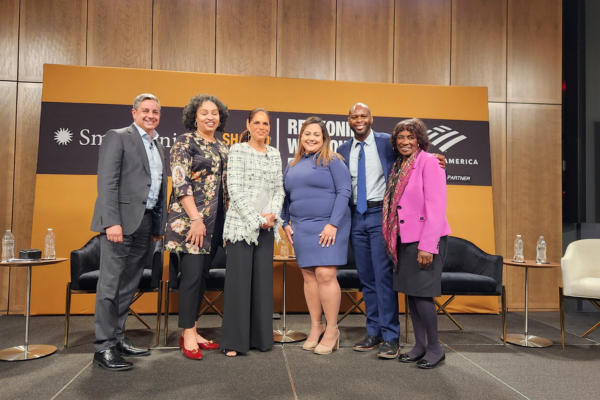
Policymakers from more than 50 cities and three states formally declared racism as a “public health crisis” in 2019, but its roots stretch back centuries. Hosted by The Smithsonian Institute, presented by Bank of America, and held at The City Club of Cleveland, “Our Shared Future: Reckoning with Our Racial Past” brought together five important leaders and innovators in race relations from across the city and country for a conversation moderated by Former CNN News Correspondent Soledad O’Brien.
Kym Carter, Berklee School of Music, ’17, performed classical and contemporary pieces during a light food and beverage reception before the start of the showcase.
It’s no secret that black and brown people have had many disadvantages when it comes to race and health; from redlining our neighborhoods and cutting us off from vital health/wellness outreach and forcing black and brown people to live in high crime areas, down to the scarcities of finding jobs in those areas that we qualify for.
Racism is the root cause of many disparities: the mistrust we have in our police & judicial systems, our health concerns consistently dismissed by doctors, and non-existent education foundations that can help advance people forward. It’s important to understand that some of the first steps in creating racial equity is to focus on the structures and systems that are already in place and dismantling them, and that it is not the fault of any one singular individual. Acknowledging the racist foundations of policies in areas such as housing and employment acknowledges the damaging effects they have had on racial disparities in health and life expectancy in the U.S.
The discussion opened up with a poetic performance from Karamu House, reading “For My People” by Margaret Walker, and “Let America Be America Again” by Langston Hughes, followed by an introductory thank you from Blaine Griffin, Ward 6 Councilman and City Council President, who discussed the importance of our city leaders coming together to have these “difficult yet necessary” discussions on race, politics, health, wellness, and how we can make all these amenities fair and equal for everyone. Griffin then introduced us to multi-award-winning journalist and CNN News Correspondent Soledad O’Brien.
O’Brien thanked everyone for coming out to the discussion and introduced the panelists:
Jorge Zamanillo, Founding Director of the Smithsonian National Museum of the American Latino
Tiffany Eubanks-Saunders, Private Bank Head of Diverse Segments at Bank of America
Jenice Contreras, President/CEO of the NE Ohio Hispanic Center for Economic Development
Marcus Madison, Community Relations Program Manager at Cleveland Clinic
Renee Powell, LPGA/PGA Golf Professional and International Golf Ambassador and Social Change Patriot.
Zamanillo understands that institutions such as museums must lead the efforts to start discussions on the widening gap between the wealthy and poor. He believes these inequalities should be addressed and we as a people should strive to show equal representation for all, but in order to do this, cities large and small must be explored to find the root causes of these disparages.
Eubanks-Saunders pointed out that Corporate America helped create the challenges that black and brown people face with attempting to climb the corporate ladder, so it’s up to Corporate America to dismantle those challenges but to do so in a sustainable way, and that resources need to be put in place in order to provide resources to citizens so they can elevate themselves and their families. The consensus is that “Corporate America cannot be successful by being a homogenous organization” and they need to reflect the different communities that they serve.
Contreras pointed out that corporations need to have proximity to the realities of the struggles of neighborhoods that they serve, in order to learn how the communities work and to see what amenities would work best for these neighborhoods to thrive. Despite the success of the campaigns she ran, it was a struggle to get basic needs for her community when it didn’t need to be.
Madison stated that while the Cleveland Clinic is one of the best hospital systems in the country, there is a huge disconnect with getting people their health needs met in order to be productive, functioning members of society. It’s a cycle of being unwell, then being unable to work, then being unable to pay rent, which tracks down to eventual homelessness. Madison believes that these chains can be broken but we must reach out to our most vulnerable populations and provide them with the resources and protections they need to survive.
Powell chimed in with her experiences being a black woman in a sport that is historically white male dominated, drawing up links that a lot of the business deals that are set up to make communities strong and wealthy happen on golf courses; with black people virtually non-existent in these spaces, they are removed from meeting and with working with the groups that can provide the upward mobility to generate generational wealth for themselves.
The panel concluded with a synopsis of the discussion by Jeremy Davis, Keynote Listener from the Reuben Group, who touched base on all the topics of the night, followed by a Q&A and meet-and-greet with the panelists.
