

Written by Terricha Phillips
WARREN, Ohio — A Trumbull County grand jury on Thursday decided to not indict a Black mother who miscarried in her home and was charged with abuse of a corpse, marking a victory in the ongoing national effort toward reproductive rights in the wake of Roe v. Wade being overturned.
Brittany Watts, 34, was told her pregnancy was not viable by medical professionals at a hospital last September, but they subsequently left her waiting for many hours after that, prompting her to return home, where she miscarried.
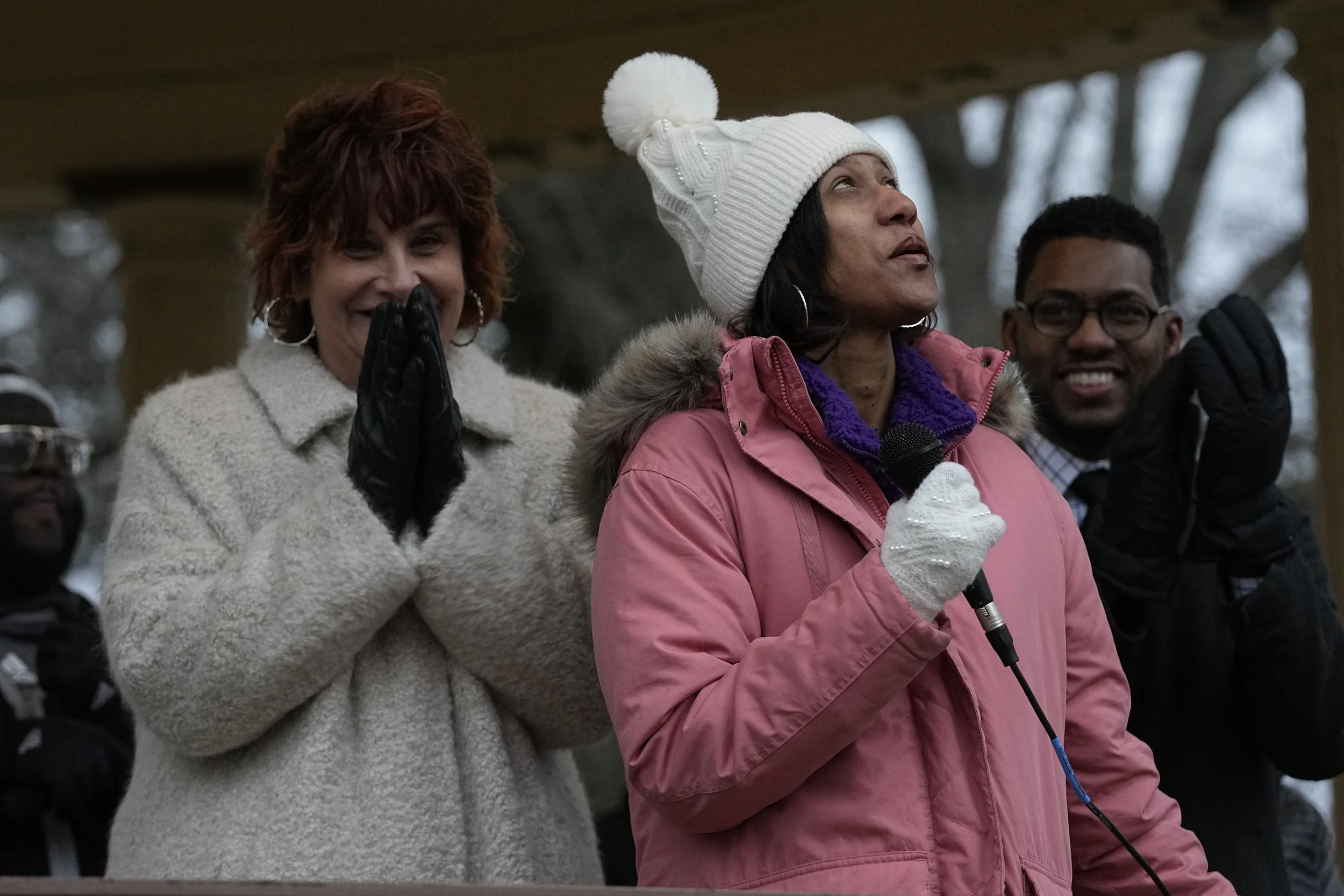
Photo from The Associated Press
Reproductive freedom advocates like MomsRising.org and Ohio Physicians for Reproductive Freedom raised their voices last year for Watts, who could have faced a felony trial after passing her fetus in her bathroom. The advocates wrote letters to county officials urging them to not criminally charge the mom of three. In Ohio, a fifth-degree felony abuse of a corpse carries a one-year prison sentence and $2,500 fine.
“The grand jury’s decision is a firm step against the dangerous trend of criminalizing reproductive outcomes,” said Dr. Marcela Acevedo, president of Ohio Physicians for Reproductive Rights (OPRR) in a statement posted to X on Thursday. Reproductive justice advocates like OPRR, a nonpartisan coalition of 4,000 doctors and healthcare professionals, have taken a stand against government intrusion on private healthcare decisions and patient rights.
“This practice must be unequivocally halted,” she continued. “It only undermines women’s rights but also threatens public health by instilling fear and hesitation in women seeking necessary medical care during their most vulnerable moments.”
The event began unfolding in late September 2023 when Watts experienced severe bleeding 21 weeks into her pregnancy and sought medical attention at Mercy Health-St. Joseph’s Hospital in Warren, a city of 40,000 outside of Youngstown. An examination revealed her water broke early resulting in amniotic fluid loss and infection putting her at risk of miscarriage, with doctors recommending inducing labor, The Associated Press reported. Watts’s attorney Traci Timko told the AP that delays and complications prompted Watts to leave the hospital.
Days of severe bleeding and pain forced Watts to return to the hospital, only to be left waiting several hours as medical staff debated how to induce labor for a woman diagnosed with preterm rupture of membranes with no detectable amniotic fluid, vaginal bleeding and advanced cervical dilation, according to a Washington Post report. Ohio law deems abortions legal until 22 to 24 weeks of pregnancy; after that, the state can legally restrict abortion access unless the patient’s life or health is at risk.
According to medical records, Watts left the hospital after being told her baby was not viable, prompting a nurse to contact emergency responders, who showed up to Watts’ home after passing the fetus in the bathroom. Authorities removed the toilet, retrieving fragments of the fetus and an autopsy revealed the cause of death as intrauterine fetal demise due to severely low amniotic fluid, CNN reported. Trumbull County prosecutors charged Watts according to Ohio law defining abuse of a corpse as “treatment in a way that person knows would outrage reasonable family sensibilities.” However, Watts’s attorney said the law does not require a mother suffering a miscarriage to bury or cremate the remains.
“(Brittany) has vowed she will do everything in her power to make sure her story is an impetus to change. We don’t stop here,” Timko told 150 people at a rally on Thursday celebrating the grand jury decision. “She has an enormous sense of community, an enormous sense of faith, and she believes that when we know better, we do better.”
Causes of miscarriage vary from chromosomal abnormality, hormonal problems, infections, maternal health problems, maternal age, maternal trauma, lifestyle or improper egg implantation in the uterus. Much attention has been drawn in recent years to the higher rates of miscarriage among expectant Black women. The Centers for Disease Control and Prevention’s National Center for Health Statistics tracked overall and unintended pregnancy rates for 2010 through 2019 that showed the percentage of pregnancies ending in live births and of those ending in loss increased three percent while pregnancies ending in abortion declined 17 percent. In 2021, The Lancet medical journal reported Black mothers have a 43 percent increased risk of miscarriage over white women.

Photo from The Associated Press
Love and support from the Warren community, calls, emails and letters from women who shared their stories helped Watts endure the ordeal. Watts, dressed in a pink winter coat and white hat, thanked God and her community for showing up when she was most vulnerable. “I was born here, I was raised here, and I graduated from high school here and I’m going to continue to stay here because I have to continue to fight (for reproductive rights of all).”
Word of the grand jury’s decision to not indict Watts spread quickly on social media and through national news. The panel’s ruling that there was not sufficient evidence for a trial came two months after 57 percent of registered Ohioans voted for the Reproductive Freedom Amendment known as Issue 1 that enshrined reproductive rights and protections into law.
The issue of maternal and infant mortality remains at the forefront of Cuyahoga County clinics and resource centers like The Village of Healing Center in Euclid, providing high-quality health services catering to the social and cultural needs of patients and families that enhance health outcomes and the eventual elimination of racial and ethnic health disparities. The 2-year-old Euclid clinic has sought past legal advice for treating patients needing reproductive or miscarriage care at the advent of Ohio’s 6-week abortion ban.
Watts’s ordeal triggered the clinic’s medical director and CEO Dána Langford, also a Black woman, who believes the outcome would have been different if the Warren woman had been white. “We passed the (Issue 1) we needed to pass and now the jury of her peers said nope, this is not criminalization,” said Langford, a certified nurse-midwife. “So we continue to show where we stand on this issue; however, it is unfortunate our elected officials don’t stand with us. It continues to remind me that in the eyes of America I am not a woman, I am something, I am property and I am a criminal immediately when I am looked at.”
This story was originally written for Black News and Views and updated to include local insights.

