

Written by: Marla Massie
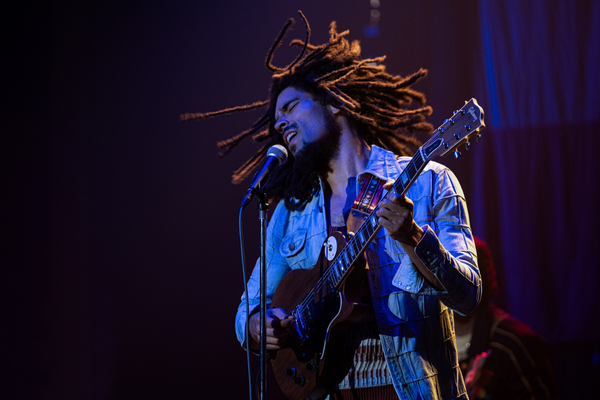
Photo courtesy of Paramount Pictures
Prior to the start of the film, Ziggy Marley gave a brief, pre-recorded intro, giving insight to why and how the movie was made; thanking the viewers for taking the time to see the finished production.
Bob’s Marley’s life chronicled in “One Love” occurs between 1976 and 1978 in the midst of a gang war and political violence in Jamaica. The film stars British actors Kingsley Ben-Adir (“One Night In Miami”, “Barbie”) as Marley, alongside Lashana Lynch (“Captain Marvel’, “The Woman King”) as Rita Marley. Supporting actors include James Norton (“Little Women”) as Chris Blackwell, founder of Island Records, and Aston Barrett, Jr. as Aston “Family Man” Barrett (Barrett Jr. playing the role of his own father).
The film opens up with brief shots of an open field engulfed in a ring of fire: a young boy runs through the circle, seemingly chased by what appears to be a colonial British soldier on horseback. The man’s true identity is unknown to the audience, and his appearance changes frequently throughout the film’s runtime; leaving his identity up for interpretation.
We are then transported forward to 1976 as Marley is preparing for the Smile Jamaica concert to protest the violence between members of The People’s National Party and the Jamaica Labour Party. After an assassination attempt on his life fails, Marley makes a self-imposed exile to England to protect himself and his loved ones. It is during this time Marley creates the new style and sound he has been searching for: a political message of life, love, and unity fused with rock, reggae, blues, and soul which becomes the 1977 album “Exodus,” often cited as one of the best records of his career, if not of all time.

Photo courtesy of Paramount Pictures
Ben-Adir’s casting is an interesting choice for the film; while he does an exemplary job at portraying the physical movements, personality, and mannerisms of the musician, Ben-Adir is 6’2″, physically fit and ruggedly handsome; a stark contrast to the 5’6″, thin-framed, scruffy Marley. The song vocals were a well-blended dub of the actor’s own singing voice over Marley’s vocals; hitting the ear a little too awkwardly for the die-hard fans but relaxed more as the film went on. Lynch, on the other hand, brings a quiet dignity and self-possession to the role of Rita, a member of the reggae group I Threes, who were the backing vocals for Bob Marley and the Wailers. The on-screen chemistry between Lynch and Ben-Adir as husband and wife looks and feels natural, even during the fallout scenes where extramarital indiscretions and paternities are discovered.

Photo courtesy of Paramount Pictures
In 1978, after being diagnosed with cancer but refusing traditional treatments, Marley returned to Kingston to perform the One Love Peace Concert to unify the two political parties for a brief moment, shaking hands and calling for a cease-fire.
More of Marley’s story could’ve been told if not for the inclusion of several other scenes such as a heated debate about an album cover and a run-in with some London street toughs at a punk show.
Marley was a spiritual man who used the Rastafari movement and his music to preach an incredible message of love and peace; unfortunately, 107 minutes barely scratches the surface on the man behind the music, the two-year time span that the majority of the film takes place or his decades-long music career in general.
In a movie where a musician has “So Much Things To Say“, why is he only given a little over an hour and a half of time to do so?
Rated PG-13. At area theaters. Contains marijuana use and smoking throughout, some violence, and brief strong language. 107 minutes.

Photo courtesy of Paramount Pictures